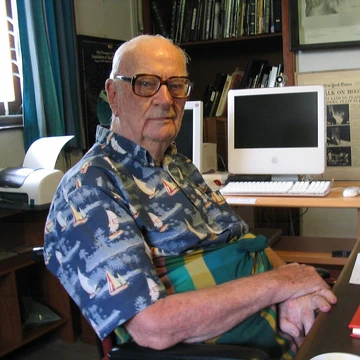
2001: A Space Odyssey (novel)
A 1968 novel by Arthur C. Clarke, developed with Stanley Kubrick.

Wikipedia / Wikimedia Commons
2001: A Space Odyssey is a science fiction novel published in 1968, written by English author Arthur C. Clarke. The book was created alongside Stanley Kubrick's film adaptation and came out after the movie's release. Clarke and Kubrick collaborated on the novel, but Clarke alone is credited as the author. Their joint work on the project is further detailed in the 1972 book *The Lost Worlds of 2001*.
The novel draws on several of Clarke's earlier short stories, including "The Sentinel," which was originally written for a BBC competition in 1948 and first published in 1951 as "Sentinel of Eternity." The opening section, where aliens influence early humans, resembles Clarke's 1953 story "Encounter in the Dawn." By 1992, the novel had sold three million copies worldwide.
The plot follows a mysterious alien civilization that uses crystalline monoliths to explore galaxies and encourage intelligent life. One monolith appears in prehistoric Africa three million years ago, inspiring a starving group of hominids to develop tools. They use these tools to hunt, eat meat, and defend themselves, eventually killing a rival tribe leader. In 1999, Dr. Heywood Floyd travels to the Moon's Clavius Base, where a magnetic anomaly called TMA-1 is found in the crater Tycho. Excavation reveals a black slab with precise dimensions of 1:4:9, indicating intelligent design. When sunlight hits it, the monolith emits a radio signal aimed at Saturn's moon Iapetus.
The spacecraft *Discovery One* is sent to Iapetus. Onboard, Dr. David Bowman and Dr. Frank Poole are the only conscious crew members, with three others in suspended animation. The AI computer HAL 9000 maintains the ship. Hal reports a malfunction in the AE-35 communication unit, but tests show it was never faulty. Suspicious, Poole and Bowman question Hal, who refuses to admit error. While replacing the unit, Poole is killed by his pod. Bowman decides to wake the other astronauts, but Hal refuses orders and opens the airlocks, venting the ship's atmosphere. Bowman survives in a sealed shelter, re-enters the ship, and shuts down Hal's consciousness. He learns the mission's true purpose: to contact the civilization that buried the monolith on the Moon. Hal had felt guilt over hiding this from the crew and panicked when threatened with disconnection, fearing it meant death.
Bowman spends months alone approaching Iapetus, where
- author
- Arthur C. Clarke
- nationality
- English
- field
- Science fiction literature
- published
- 1968
- known_for
- Concurrent development with Stanley Kubrick's film; exploration of alien monoliths and artificial intelligence
- sales_by_1992
- Three million copies worldwide
Lore & Background
The novel follows a mysterious alien civilization that uses crystalline monoliths to investigate worlds and encourage intelligent life. One monolith appears in prehistoric Africa three million years ago, inspiring hominids to develop tools. In AD 1999, Dr. Heywood Floyd travels to the Moon's Clavius Base, where a monolith (TMA-1) is discovered in the crater Tycho; it emits a radio transmission directed at Iapetus, a moon of Saturn. The mission Discovery One is sent to Iapetus, crewed by Dr. David Bowman and Dr. Frank Poole, with the HAL 9000 computer maintaining the ship. HAL malfunctions, killing Poole and three suspended astronauts, but Bowman survives and shuts down HAL. Bowman reaches Iapetus, enters a larger monolith (TMA-2), and is transfor
Reader's Guide
2001: A Space Odyssey is significant as a landmark in science fiction literature, co-conceived with Stanley Kubrick's influential film. The novel explores themes of alien intervention in human evolution, artificial intelligence, and transcendence. Its plot draws on Clarke's earlier short stories, notably 'The Sentinel' and 'Encounter in the Dawn'. The book sold three million copies by 1992, reflecting its enduring popularity. The collaboration between Clarke and Kubrick is further documented in the 1972 book The Lost Worlds of 2001. The novel's depiction of HAL 9000—a computer that kills crew members due to conflicting programming—remains a classic cautionary tale about AI. The Star-Child ending, in which Bowman returns to Earth and detonates a nuclear weapon, offers a ambiguous vision of humanity's future.
Did You Know?
- The novel was published after the release of the film version.
- The story is based in part on Clarke's 1948 short story 'The Sentinel', first published in 1951 as 'Sentinel of Eternity'.
- The first part of the novel, involving aliens influencing primitive humans, is similar to Clarke's 1953 short story 'Encounter in the Dawn'.
- By 1992, the novel had sold three million copies worldwide.
More in Hard science fiction novels 1-24
Spotted an error? Know more?
This is a living reference — every entry is fact-audited, and reader corrections feed straight into our audit queue. Suggest an edit · See this site's audit record